A Pawn in a Cruel Political Game’
A Pawn in a Cruel Political Game’
Iran is threatening to execute an Iranian Swedish doctor—and human rights activists say the West isn’t doing enough.
Foreign Policy | Anchal Vohra | JUNE 3, 2022
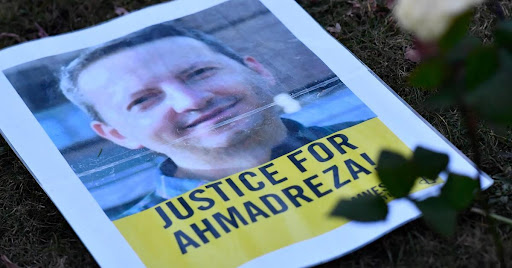
Every night, Vida Mehrania fears going to bed, worried that she might wake up to the news that her husband, Ahmadreza Djalali, has been hanged. In April 2016, Djalali, an Iranian Swedish physician in disaster medicine, left his home in Sweden for a two-week workshop in Iran at the invitation of the University of Tehran. A few days after his arrival, he was arrested on the charge of spying for Israel and helping its assassination of two Iranian nuclear scientists. The following year, after a trial that was criticized by human rights organizations, the country’s revolutionary court sentenced Djalali to death.
It’s been six long years for his family, who have been holding out hope that the Swedish government or the European Union might somehow get Djalali back. But their anxieties rose again last month when Iranian officials said they would carry out the execution. “They can do it any day now. Every minute is difficult for us,” Mehrania told Foreign Policy on the phone from Stockholm, where she lives with their 19-year-old daughter and 10-year-old son. “What am I supposed to tell my children, who have been waiting for their father to return home?”
The timing of the announcement is notable in that it coincided with the end of a war crimes trial in Sweden against former Iranian prison official Hamid Noury. Noury was detained in a Swedish airport in 2019 for his alleged role in the 1988 prison massacre, where Tehran killed thousands of dissidents. During his trial, Iranian witnesses testified that he handed down death sentences among other alleged crimes. The prosecution is seeking a life sentence for Noury, and the verdict is scheduled to be delivered in July. (Noury denies the charges.)
The two men’s fates, it seems, are now intertwined. Although Iran’s judiciary spokesperson, Zabihollah Khodaian, has said the cases are not related, activists and experts believe Tehran is leveraging the threat of Djalali’s execution to blackmail Stockholm into releasing Noury. Noury’s conviction would carry huge symbolic meaning inside Iran, as the country’s hard-line president, Ebrahim Raisi, served on a committee that issued the execution orders carried out by officials like Noury. According to Mahmood Amiry-Moghaddam, director of Iran Human Rights, a Norway-based group that monitors death penalty cases in Iran, people like Raisi “thought whatever they did had been forgotten.” But if Noury can be charged and even convicted, perhaps Raisi could one day also be held accountable.
Iranian authorities are using Djalali “as a pawn in a cruel political game,” said Diana Eltahawy, Amnesty International’s Middle East and North Africa deputy regional director. They’re escalating their threats to execute him, she said, in retaliation for Noury’s trial as well as trying to “pervert the course of justice.”
Analysts told Foreign Policy this is part of Tehran’s clear pattern of using dual nationals and Westerners in negotiations with the West. “As with most of these cases, Iran is trying to bargain,” said Ray Takeyh, an Iran expert at the Council on Foreign Relations. “In this manner, they terrorize the innocent captives in order to free their agents abroad.”
“As long as each country pursues its individual hostage diplomacy with Iran, the shameful practice will continue.”
It’s a tactic Iran has honed over time. In 1990, Tehran reportedly brokered a swap between the French government and Iran-backed militia group Hezbollah in Lebanon: Paris agreed to release Anis al-Naqqash, a Lebanese politician and guerrilla fighter who had been sentenced to life in prison in a French court for his role in a failed attempt to assassinate a former Iranian prime minister, in exchange for eight French citizens taken hostage by Hezbollah. In 2016, Tehran released four American citizens after the United States and Iran signed the nuclear deal. This March, two British citizens—Nazanin Zaghari-Ratcliffe and Anoosheh Ashoori—returned home from six years in Iranian prisons after Britain settled a $499 million debt to Iran dating back to the 1970s.
Djalali is among a number of dual nationals and Westerners still detained in Iran after visiting the country for business or family. In May, a few days after Iran renewed its threat to execute Djalali, two French nationals in Iran were arrested for allegedly wanting to take advantage of Iranian teachers’ protests and provoke unrest. Stockholm has said another Swede was arrested this month while visiting with other tourists. Iran has yet to provide a reason for the arrest.
Now, there are at least four Americans, two Germans, two Austrians, two French citizens, and another Swedish national detained in the country. Nearly all have been charged with “collaborating with hostile states” or spying for Israel. Although the details of their detainment are not known, United Nations experts and international organizations have long expressed concern over reports of Iran torturing detainees.
“[Djalali] was thrown in solitary confinement, tortured, and forced to confess on Iranian television,” Mehrania said. The United Nations has also said Djalali’s confession was extracted under torture.
Four years before Djalali’s arrest, hundreds of Iranians were arrested on the same spying charges as Djalali. One of them, Iranian businessman Mazyar Ebrahimi, said he was held and tortured in the same prison as Djalali.
“They whipped my feet with electric cables, handcuffed me, and hung me from the ceiling. They beat me with whatever they could find and, on three occasions, strangled me with a rope, nearly killing me to force a confession,” Ebrahimi told Foreign Policy via encrypted communications from Germany, where he now lives as a refugee. “I was ready to say whatever they wanted me to, so I gave a false confession that I played a role in the killing of the scientists. I have no doubt that is exactly how they got Djalali’s confession.”
Although Westerners face similar threats if they travel to Iran, regardless of their specific nationality, U.S. and European governments’ responses to Iran detaining their citizens are far from united. “What is needed is collective action,” said Ali Vaez, the Iran project director with the International Crisis Group. “As long as each country pursues its individual hostage diplomacy with Iran, the shameful practice will continue.”
Washington has long issued a travel advisory cautioning its citizens against traveling to Iran, and Stockholm followed in April when it advised Swedes to avoid all nonessential travel to the country. “Foreign travellers can be arbitrarily detained and prosecuted without clear reasons,” read the statement by Sweden’s foreign ministry. Activists, however, believe travel advisories are a cop-out by Western governments that refuse to do more.
“They issue advice not to travel, but [the] rest is business as usual to maintain business relations,” Amiry-Moghaddam said. “They don’t call it a hostage crisis because then they must consider all their relations with Tehran, and they haven’t been willing to do that.” Essentially, Western countries don’t want to risk diplomatic ties and future business deals with Iran over this issue—especially as they’re holding out hope for a revived nuclear deal, Amiry-Moghaddam said. And if the nuclear deal goes through and the United States lifts its sanctions on Iran, European companies intend to renew business with the country.
But even if the deal is revived, Westerners will find it hard to travel to and invest in Iran as long as the threat to their safety persists. “In 2015, Iran’s arrest of Siamak Namazi, an American Iranian businessman, drove away billions of dollars of Iranian diaspora’s capital,” Vaez said. “The Iranian leadership seems incapable of understanding the oft-repeated saying that capital is a coward.”
Yet while Iran continues arresting foreigners, it is also aiming to open up its doors to tourists and develop its tourism industry. It has also discussed offering visas on arrival to fans traveling to nearby Qatar for the World Cup later this year—including those from Britain, Canada, and the United States, according to the Iranian press.
But unless Iran finally puts an end to the 43-year-old policy that began with the Iran hostage crisis, when Tehran held 52 Americans hostage at the start of the Iranian Revolution in 1979, Westerners are bound to think twice before traveling there.
For now, the fate of foreign nationals languishing in prisons hangs in the balance. Robert Malley, the U.S. special envoy for Iran, said in January that the U.S.-Iran nuclear deal is unlikely to be revived without the release of the four Americans held captive in Iran. Meanwhile, Swedish Foreign Minister Ann Linde has said Stockholm and the EU have taken up Djalali’s case with the Iranian authorities several times to demand his release. But Mehrania, Djalali’s wife, believes the bloc needs to do more to save her husband’s life.
“Every day, when I drop my son to school, he asks me, ‘When will he come back?’” Mehrania said. “I keep looking at the bus stop, dreaming he will step out of the bus one day, and we will be able to resume our lives.”
https://foreignpolicy.com/2022/06/03/iran-hostage-diplomacy-sweden-djalali-noury-westerners-tourism/