The Regime’s Pen: How Iran’s Clerical Dictatorship Uses Friendly Journalists as Propaganda Assets
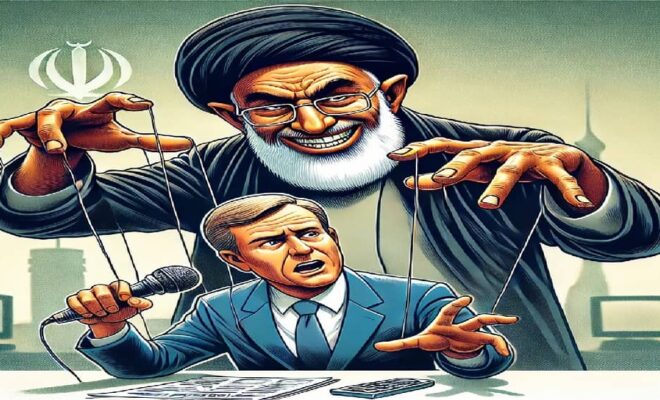
It began with a strange email.
In 2015, veteran national security reporter Shane Harris opened his inbox to find an invitation—an all-expenses-paid trip to Tehran, a “scientific and creative” conference on the theme of terrorism. The sponsors? A group called the “International Congress on 17,000 Iranian Terror Victims,” whose website was adorned with themes like “Zionist State Terrorism,” “Cyber War,” and “Economic Terrorism.” But beneath the awkward grammar and conspiratorial flair, Harris spotted something serious: among the sponsors were the Iranian Ministry of Foreign Affairs and the Ministry of Intelligence (MOIS), and the keynote at the previous year’s event had been delivered by the head of Iranian intelligence himself.
The message was clear: the clerical regime in Tehran wasn’t just inviting Harris to speak—it was trying to recruit him, to enlist a credible Western journalist into its propaganda machine. He declined, but the episode opened a window into one of the regime’s most underappreciated tactics: the quiet co-opting and coercion of journalists, both foreign and domestic, in its war of narratives.
And at the center of that war? The regime’s obsessive campaign to discredit, isolate, and ultimately neutralize its most potent existential threat: the pro-democracy Iranian Resistance, led by the National Council of Resistance of Iran (NCRI) and its main component, the Mujahedin-e Khalq (MEK).
The Ministry’s Invisible Ink
Ali Fallahian, a former Iranian intelligence minister and one of the masterminds of the 1994 AMIA bombing in Argentina, once admitted it openly on regime television: “We don’t send agents abroad with a badge. Obviously, they need cover—businessmen, academics, reporters. Many of our reporters are actually ministry agents.”
It wasn’t just bravado. Over the years, Iran’s Ministry of Intelligence has cultivated an extensive network of “friendly journalists”—some homegrown, others foreign correspondents—who either knowingly or naively advance Tehran’s objectives. Those who play along are granted rare access, interviews, press visas, and even guided tours. Those who don’t face surveillance, censorship, or worse.
Armin Arefi, a French-Iranian journalist for Le Point, learned this the hard way. After years of reporting from Tehran, his press card was abruptly revoked in 2007. When he was eventually allowed to return in 2016, he found the gatekeeper was a man named Nejati—an agent of a “semi-official” agency more powerful than the Iranian embassy itself. Nejati’s message was blunt: write something on the MEK. No pretense. Just a thinly veiled quid pro quo. When Arefi refused to toe the line without hearing both sides, Nejati became aggressive. It turned into what Arefi called “a sort of blackmail” centered on the MEK.
Eventually, Arefi did publish an article that parroted tired regime talking points: that the MEK is a “cult,” “extremely unpopular,” and “seen as traitors.” He sourced known anti-MEK propagandists, many with ties to the MOIS. And when the NCRI submitted a rebuttal, Le Point quietly deleted it.
This wasn’t an isolated case. It was part of a broader pattern.
Credential as Collateral
Consider the strange disappearance of New York Times Tehran bureau chief Thomas Erdbrink. In February 2019, he published a piece marking the 40th anniversary of the Islamic Revolution. It was more deferential than critical, but apparently not deferential enough. Days later, Erdbrink vanished from the bylines. No explanation. No farewell tweet. For months, the Times stayed silent. When it finally acknowledged his absence, it claimed the regime had revoked his credentials—but gave no details, no pushback.
Why such restraint from one of the world’s most influential papers?
The answer may lie in the calculus of access. Erdbrink had built a life in Iran, complete with an Iranian wife, deep ties, and local fluency. His documentary Our Man in Tehran aired scenes of ordinary Iranians grappling with repression, yearning for change, or emigrating in despair. For Tehran’s intelligence apparatus, that was a red line. His punishment wasn’t prison, but professional erasure—a tactic calculated to avoid diplomatic costs while sending a clear message: we own the rules of engagement.
Erdbrink’s successor, Farnaz Fassihi, adopted a very different tone. After Qassem Soleimani’s killing in 2020, she reported that “Iranians close ranks behind leaders,” praising the “popular general” in language indistinguishable from regime press. She’s since drawn criticism for downplaying the 2019 massacre of 1,500 protesters and amplifying regime talking points while casting doubt on opposition sources, especially when it comes to the MEK.
When Journalism Meets Espionage
The regime’s strategy isn’t limited to subtle coercion. Sometimes, it’s espionage dressed as journalism.
The German magazine Der Spiegel published a piece in 2019 titled “Prisoners of the Riots,” purporting to expose conditions at Ashraf 3, the MEK’s base in Albania. But the article relied almost exclusively on discredited “witnesses” with ties to the MOIS. One of them, Gholamreza Shekari, had his interview posted on MOIS-linked websites months before Der Spiegel published the piece. Another, Mostafa Mohammadi, had his wild claims about his adult daughter “being held hostage” dismissed by courts in three countries.
And the journalist behind the story, Louisa Hommerich? She had studied in Iran for two years, was embedded with the Basij—the same paramilitary force infamous for beating protesters—and had participated in their military exercises. She was offered a level of access no foreign journalist receives without regime approval.
The NCRI invited Der Spiegel to visit Ashraf 3, interview current members, and verify facts. The magazine declined. Instead, the regime’s narrative went to print under the Spiegel masthead—on the very week the NCRI was gaining global traction at the Warsaw Summit.
The Propaganda Pipeline
Tehran’s propaganda machine isn’t just reactive; it’s proactive. Groups like Habilian, masquerading as NGOs, pump out English-language books, articles, and conferences aimed at rebranding the regime as a “victim of terrorism” and the MEK as the perpetrator. They recruit fringe academics, conspiracy theorists, and even white supremacists to launder their talking points. The goal: manufacture consent, or at least confusion.
This is not journalism. These are influence operations. And as former MOIS minister Fallahian confessed, it runs through agents “posing as reporters.”
The ultimate aim isn’t to persuade the masses, but to demoralize the opposition, to isolate the NCRI and MEK from potential allies, and to muddy the waters just enough that Western policymakers hesitate to act.
A Dangerous Normalization
Iran’s rulers understand the power of narrative. They fear the MEK not because of the past, but because of the future it represents: an organized, secular, pro-democracy alternative that resonates with a population fed up with clerical rule. That’s why they invest in misinformation with surgical precision.
Meanwhile, in Western capitals, the question isn’t whether the regime in Iran is weaponizing journalism—it is. The real question is: why are some of our most respected media institutions letting them?
Because in the fog of propaganda, silence becomes complicity. And when journalism is hijacked by tyrants, truth itself becomes a casualty.