Trump says the Iran endgame is here. It isn’t — without regime change
Published | BySofey Saidi | September 29, 2026
Regime change is returning to the policy discussion over Iran, not as a call for another U.S.-led intervention but as a strategic question about whether lasting regional stability is possible while the political system at the center of repeated confrontation remains unchanged.
The shift is increasingly visible. At this year’s U.N. General Assembly, Slovenian Prime Minister Janez Jansa argued that lasting peace in the Middle East requires political change in Iran. Retired Lt. Gen. Keith Kellogg similarly linked Tehran put a bounty on US troops. Why is Trump still playing defense?
Middle East requires political change in Iran. Retired Lt. Gen. Keith Kellogg similarly linked Tehran put a bounty on US troops. Why is Trump still playing defense?
Trump has a ‘big stick’ in Iran. He forgot to bring a brain
The Trump administration has not declared regime change its objective, but its own language points to a broader ambition for the pressure now being applied. In announcing Operation Economic Outcast in August, the White House said the United States was “entering the endgame.” Treasury Secretary Scott Bessent went further: “America is no longer managing the Iranian threat — we are ending it.”These are not declarations of a new U.S. regime change doctrine, but they do mark an important shift in the strategic conversation. The discussion is moving beyond how to manage the Islamic Republic and toward whether managing it should remain the objective at all.One way to understand that distinction is through two different approaches to Iran. A transactional strategy uses pressure to extract changes in behavior. A transformational strategy recognizes that durable change may require confronting the political conditions that repeatedly produce the same crises.The first approach has long shaped U.S. policy toward Tehran: pressure creates leverage, leverage leads to negotiations, and negotiations seek concessions over nuclear activities, regional conduct, shipping, or other immediate security concerns. The result may be a transaction, but it does not necessarily amount to a strategy for resolving the underlying conflict.
Advertisement
Different administrations have employed different instruments and sought different bargains, while largely sharing one assumption: The Islamic Republic itself remained a fixed feature of the strategic landscape.
The June memorandum between Washington and Tehran offers a recent illustration of the limits of that assumption. It sought to halt hostilities, restore commercial passage through the Strait of Hormuz, and establish a period for broader negotiations. In return for Iranian commitments, Washington agreed to measures that included lifting its naval blockade, providing oil-related sanctions waivers, and releasing restricted Iranian assets. The memorandum also contemplated a reconstruction and economic development plan of at least $300 billion.
Yet some of the most consequential issues were postponed rather than resolved. The Hormuz provision required Iran to use its “best efforts” to facilitate commercial passage while leaving the waterway’s future administration to subsequent discussions. Washington and Tehran soon advanced sharply different interpretations of what had been agreed. The arrangement addressed an immediate crisis without resolving the strategic contest that produced it.Washington now again possesses considerable leverage. Operation Economic Outcast targets Iran’s financial connections, aviation, shipping, technology, and other sources of revenue. The White House describes a “zero-leakage approach” intended to deny the regime economic space to rebuild its capacity.
The strategic issue is what Washington intends to accomplish with that leverage. Even after rejecting Tehran’s latest proposal, President Donald Trump says he expects further talks with Iran this week, so the possibility of another agreement remains very much alive.
If “endgame” means applying extraordinary pressure only to secure another agreement, it amounts to the same failed policy under a more ambitious name. A genuine endgame would have to confront the reality that recurring confrontation cannot be separated indefinitely from the political system that produces it.That is why the return of regime change to the policy discussion matters. Uncertainty about when or how political change might occur is not a reason to exclude the durability of the political system from strategic analysis. It is equally important, however, to distinguish regime change in Iran from regime change by the United States. The first concerns whether Iranians ultimately replace their political system; the second implies that Washington undertakes to replace it for them.U.S. strategy can recognize the prospect of internally driven regime change without making preservation of the Islamic Republic an implicit objective of its Iran policy. This does not necessarily require more sanctions or more military action, nor does it require the U.S. to choose Iran’s future leaders. There is another course: recognize and engage the organized democratic opposition as a legitimate force for transition.
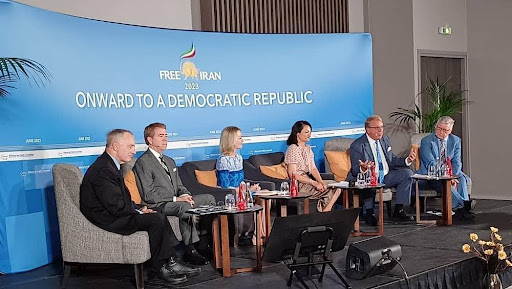
The National Council of Resistance of Iran offers one such framework. Its proposed provisional government is presented not as a permanent successor government but as a mechanism for transferring sovereignty to the Iranian people. Under the NCRI’s plan, the provisional government would serve for no more than six months, during which free elections would be held for a national legislative and constituent assembly. Political authority would then pass to the elected representatives.
The political framework accompanying that transition is set out in Maryam Rajavi’s 10-point plan, which calls for universal suffrage and political pluralism, freedom of speech and association, separation of religion and state, gender equality, an independent judiciary, and a non-nuclear Iran.
Recognizing and engaging such an alternative would not amount to choosing Iran’s next government. It would instead abandon the assumption that the existing regime is the only political reality with which the West can engage, while leaving Iran’s ultimate political order to the Iranian people.
That distinction also changes how U.S. policy should be evaluated. A policy centered on bargaining measures success primarily by the concessions Washington extracts. A strategy oriented toward political change must consider the longer-term consequences of sanctions relief, the release of frozen assets, or other concessions, including whether they reinforce the institutions responsible for the confrontation in the first place.
Political change, if it comes, ultimately must come from the Iranians themselves. Washington cannot manufacture legitimacy, choose Iran’s future leaders, or guarantee the outcome of a transition. Recognizing those limits, however, does not require treating survival of the existing system as necessary for stability.
Washington still has immediate problems to contend with, including Hormuz, nuclear restrictions, and sanctions. But behind them lies the larger issue now entering the policy discussion: whether nearly five decades of recurring confrontation with Tehran can be permanently separated from the political system that produces it.
Washington has not formally adopted regime change as its objective, and no Western consensus has emerged around it. What has changed is that regime change can no longer be so easily excluded from serious strategic discussion.The administration says it has entered the endgame with Iran. It now needs to define the end state. Another agreement may manage the next crisis, but a genuine endgame must address what comes after it.Regime change has returned to the Iran debate. Its significance lies not in whether Washington can produce it but in whether U.S. strategy should continue to assume that preventing it is necessary for stability.Sofey Saidi is a Regime change has returned to the Iran debate. Its significance lies not in whether Washington can produce it but in whether U.S. strategy should continue to assume that preventing it is necessary for stability.
Sofey Saidi is a scholar-practitioner specializing in international relations, democratic transitions, and Middle East security. She holds a Ph.D. from the Geneva School of Diplomacy and advanced degrees from George Mason University’s Carter School for Peace and Conflict Resolution and Duke University. She also hosts the Iran Brief podcast and writes on U.S. foreign policy, democratic transitions, and regional security. Website: sofeysaidi.com.