One Iranian perpetrator gets a life sentence. Another is potentially set free
One Iranian perpetrator gets a life sentence. Another is potentially set free
Atlantic Council | By Celeste Kmiotek | July 26, 2022
July was bittersweet for human rights lawyers and activists, particularly those working on Iran. On July 14, the Stockholm District Court announced that former Iranian official Hamid Nouri was found guilty of war crimes and mass murder and was sentenced to life in prison.
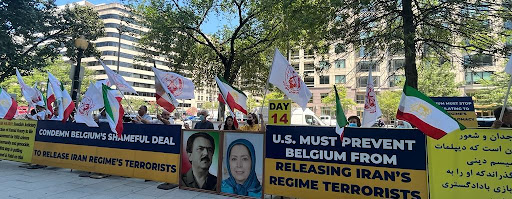
Just days later, on July 21, the Belgian parliament ratified a mutual legal assistance treaty that allows Iranian offenders imprisoned in Belgium to serve their sentence in Iran and vice versa. The treaty is widely assumed to serve as a codified prisoner swap to exchange European nationals held hostage in Iran, such as Belgian aid worker Olivier Vandecasteele, for former Iranian diplomat Assadollah Assadi, a convicted terrorist serving his sentence in a Belgian prison for an attempted bombing of an Iranian opposition rally. While the conviction has been internationally celebrated, the treaty has been internationally condemned.
Nouri’s verdict was a triumph of justice, marking the first ever conviction in a court of law for a perpetrator of the 1988 prison massacres, during which thousands of political prisoners were mass executed. Nouri was a deputy prosecutor during the massacres and was found to have knowingly and intentionally sent prisoners to death without fair trials. The verdict is monumental legally, further strengthening jurisprudence about the relevant crimes, the facts of the massacre, and procedural matters. On an emotional level, it allowed victims’ families to finally see at least one individual face consequences for their crimes. Additionally, from a policy perspective, it showed the power that countries committed to justice had to render it where needed and to deny perpetrators overseas safe havens.
The Belgian treaty, however, casts a dark shadow over the news. It allows one immediate and obvious benefit that cannot, and should not, be ignored: it allows Vandecasteele to return home. Prisoner swaps—official and unofficial—are not uncommon in state-sponsored hostage cases and have been used to return hostages held in Iran, including Iranian-American journalist Jason Rezaian and Australian-British academic Kylie Moore-Gilbert. However, while Vandecasteele and all other hostages deserve immediate release, they also deserve justice. Unlike ad hoc exchanges, the Belgian treaty is permanent, with sweeping and long-lasting damage to global accountability efforts.
First, the treaty creates a false equivalency between the Belgian and Iranian legal systems. An agreement between two states, which would allow legitimately convicted individuals to serve out their sentences at home, in a way that would make the sentence as fair and humane as possible, would be laudable. The two states have not, however, legitimately convicted the individuals—only one has. Belgium will exonerate returned detainees because of their innocence. Iran will do so because of corruption. Countless victims and their relatives have detailed the sham trials conducted by the Iranian judiciary. Indeed, members of the Iranian judiciary, including judges, are considered to be human rights offenders.
The Working Group on Arbitrary Detention (WGAD)—a subsidiary body of the United Nations and one of the few mechanisms with jurisdiction over Iran’s practice of state-sponsored hostage taking—has found on over thirty-seven occasions that an Iranian detention was arbitrary at least in part due to fair trial violations. By even suggesting parity between the two systems, the treaty undermines these findings, weakening leverage in negotiating releases while also impeding accountability efforts that could provide justice for hostages.
Second, the treaty effectively turns Belgium and any countries that follow suit into safe havens for perpetrators of serious international crimes. While perpetrators could still be tried in Belgium under universal jurisdiction—which allows countries to try perpetrators no matter their nationality or the location of the crime, and which was the basis by which a Swedish court was able to try Nouri—the treaty limits the outcome of such a trial to establishing the facts on the record, creating legal precedent, and deportation. This renders the outcome only slightly more effective than Magnitsky-style sanctions, which freeze perpetrators’ assets and ban them from obtaining visas, while requiring considerably greater risk and effort from witnesses and law enforcement.
It is unlikely that victims and witnesses will choose to pursue a case given the changed cost-benefit analysis, and it is even more unlikely that Belgian authorities will be motivated to take on a case if asked. Iranian perpetrators (except those who are subject to Magnitsky-style sanctions in the European Union) now have effectively free reign to vacation or even resettle in Belgium, evading accountability while also endangering victims who previously fled there.
Such a safe haven entrenches and widens the impunity already enjoyed by perpetrators within Iran. Iran has maintained a tough veil to pierce when it comes to justice, creating a bubble where perpetrators can face virtually no consequences as long as they remain in-country; there are no reliable domestic accountability options, Iran is not a party to the International Criminal Court, and there are no regional human rights courts it could be a part of.
Universal jurisdiction offers one of the only outlets available for Iranian victims to seek recourse. However, it is already constrained by the limited number of countries with such provisions, as well as hurdles, such as requiring the perpetrator to be present before investigating or by only allowing prosecutions of crimes occurring after certain dates. The Belgian treaty narrows this option even further by effectively taking Belgium off the table for trials and, if other European countries follow suit, this may eliminate realistic options for universal jurisdiction completely.
Finally, while this increased impunity is devastating for victims of past crimes, it guarantees that Iranian officials will be emboldened to escalate their already extensive crimes, especially transnationally. While Belgium is not explicitly endorsing such crimes through the treaty, it tacitly accepts that they will continue without consequence. This endangers all Iranians, but especially those in Belgium—including any witnesses who testified against Assadi—who no longer have access to sufficient remedies.
Family members of the victims of the 1988 massacre waited just shy of thirty-four years for any accountability. They, and all victims of Iranian human rights violations, deserve to take time to celebrate justice, remember their loved ones, and hope for continued international support. Instead, their sense of justice has been tinged by the specter of ongoing impunity. Belgium should reconsider this negative path. And all other nations with a strong rule of law must immediately unite to support the families of the 1988 victims and all others affected by Iranian atrocities by strengthening, not undermining, accountability options.
Celeste Kmiotek is a staff lawyer with the Strategic Litigation Project at the Rafik Hariri Center and Middle East Programs.